

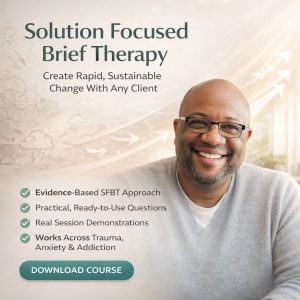



Elliott Connie – Solution Focused Brief Therapy: An Evidence-Based Approach to Create Rapid, Sustainable Change with Any Client
Would you like to see more progress in session? Have you found yourself stuck with certain clients, addressing the same problems and symptoms week after week? Would you like to see your clients transform themselves into the most positive, creative, and motivated people they can be, regardless of presenting problem or diagnosis?
It’s time to incorporate Solution Focused Brief Therapy into your clinical toolbox!
Solution Focused Brief Therapy (SFBT) is an evidence-based, straightforward, result-driven approach to therapy that helps clients become “unstuck” by drawing on their already existing resources and personal strengths. Through easy to learn, simple interventions and principles, SFBT offers you a whole new perspective of what therapy can do.
Watch Elliott Connie, SFBT trainer, author and psychotherapist, as he walks you through the philosophical shift from problem to solution-oriented therapy that will completely change your practice. No tricks, no theoretical rhetoric that takes years to understand – just simple, practical, innovative strategies that will transform your clients’ relationship with their perceived problem.
In this dynamic, engaging training, you’ll have the unique opportunity to share your thoughts, practice the skills, and even watch an SFBT session from start to finish so you’ll know exactly how to use it in your own office!
Breathe new life into your practice !
Who should takes the course
- Psychiatrists
- Psychologists
- Counselors
- Social Workers
- Licensed Clinical/Mental Health Counselors
- Addiction Counselors
- Psychotherapists
- Therapists
- Marriage & Family Therapists
- School-Based Psychologists Teachers
- Case Managers
- Other Helping Professionals
Learning Objectives:
- Utilize specific solution-focused strategies, including miracle and best-hopes questions to improve clinical outcomes.
- Compare the benefits of utilizing a solution-focused approach versus other evidence-based treatment models.
- Implement solution-focused interventions that shift the conversation from “problem talk” toward productive, solution-oriented talk.
- Assess the practical benefits and limitations of utilizing a solution-focused treatment approach with clients.
- Summarize the current research related to the efficacy of a solution-focused approach to treatment.
- Implement the structure and questions of the Solution Focused Approach with their clients in an ethical way.
Course Modules / Outline
What Distinguishes SFBT From Traditional Approaches
- Key tenets, theory and evidence behind SFBT
- How important is the problem?
- Why assessment, diagnosis and treatment planning doesn’t guide treatment
- ”The details drive the change”
- The absence of symptomology v. the presence of what clients most desire
- What are the two most important words in SFBT?
Intentional Questions: The Strength Behind SFBT
- Reframe questions as invitations
- How to build questions that:
- Lead to meaningful answers
- Create change that sticks
- Harness your client’s strengths and resources
- Immediately replace resistance with buy-in
- Keep the client engaged throughout session
- Core SFBT questions:
- Desired Outcome: Discover what clients want to be different in their lives
- Resource Talk: Activate the client’s strengths
- Preferred Future: Elicit a detailed description of what the client wants
- Scaling: Measure progress toward the desired outcomes
- Coping Questions: Find positive resources even in difficult situations
Inside a SFBT Session: Innovative, Practical Strategies from Start to Finish
- Opening the Session
- Why your first few interactions are crucial
- How to elicit hope right away
- Key questions to instantly shift the client’s perspective
- The Core of the Session
- Working with one problem at a time
- Strategies to build momentum toward the client’s hoped for future
- Tolerating silence and using it as a valuable tool
- What to do when the client is focused on problems and symptoms
- Techniques to keep the client engaged and the session meaningful
- Closing the Session
- Specific strategies for effective session closure
- Increase likelihood of between-session work
- Video case examples: See each step in action!
SFBT Across Settings and Populations
- School-based SFBT
- Group therapy
- Children, adolescents and families
- Couples
- Addictions, trauma and severe mental illness
- Multicultural factors
- Ethical considerations
- Limitations of the research and potential risks
Meet the Course Expert:

Elliott Connie, MA, LPC, is a Texas-based psychotherapist in private practice and the founder/director of The Solution-Focused University, an online learning community that trains and provides resources for professionals who want to master the Solution Focused approach in their work. Over the course of his 15-year clinical career, Elliott has successfully worked with thousands of individuals, couples, and families using a solution-focused model to help them achieve their desired outcomes. He is an experienced speaker who has gained international recognition for training hundreds of practitioners throughout the United States, Australia, Europe and Asia on the solution-focused treatment model. Elliott is the author/co-author of four books, including Solution-Focused Brief Therapy with Clients Managing Trauma (Oxford University Press, 2018), The Solution focused Marriage: 5 Simple Habits That Will Bring Out the Best in Your Relationship (The Connie Institute, 2012), Solution Building in Couples Therapy (Springer, 2012), and The Art of Solution Focused Therapy (Springer, 2009).


Reviews
There are no reviews yet.