
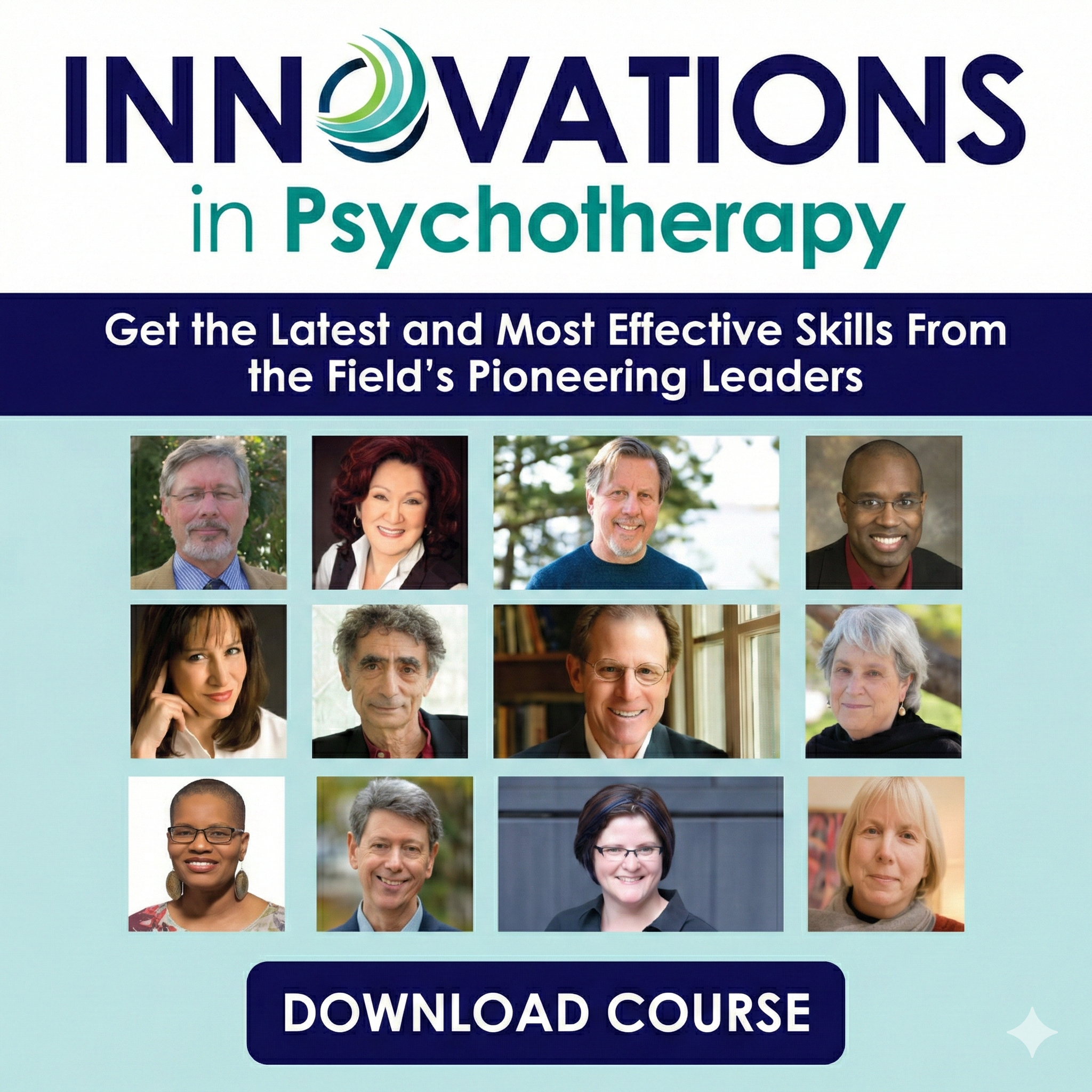


What’s New & What’s Next in Psychotherapy
Learn First-Hand with the World’s Leading Clinicians and Researchers to Improve Your Outcomes & Re-ignite Your Passion for Therapy
Psychotherapy has continued to evolve and change rapidly, with new ideas and interventions that can change our clients' lives... …But if you’re like most clinicians, it’s been hard to keep up.
That’s why we’re inviting you to take home the Innovations in Psychotherapy conference and experience it at your own pace... the one-stop course for what’s working NOW and what’s just around the corner.
We invited the leading clinicians and researchers, those you know and those you may not have heard of yet, to share their truly groundbreaking insights — many of which aren’t yet widely available.
Here’s just a sampling of what you’ll learn:
Single Session Interventions
Jessica Schleider, the leading researcher on this topic, will definitely answer the question: if you only have one client session, here’s what you do.
What’s Really New in Trauma Treatment
Hear the latest trauma insight from Bessel van der Kolk. Plus, learn about new methods from innovators including Kate Chard, Eboni Webb, Lisa Najavits, and more.
Exposure Therapy: Can it really work?
Lisa Coyne (President of ACBS) says "Yes!" – if you follow this new, essential way of applying it.
Walk-and-Talk Therapy
You’ve already transitioned to teletherapy, now it’s time for the next step. Join Jen Udler to learn how and why you should add this intervention to your practice.
Psychopharmacology
Psychopharmacology expert Ken Carter has a LOT of essential insight to share on why you can and should do more with medications to help your clients.
Emotionally Focused Individual Therapy (EFIT)
Sue Johnson brings the science of attachment and love, well-known for helping couples, to individual client work.
Neuroscience: What Therapists Need to Know
Leading experts Dan Siegel, Rick Hanson, and Alex Korb share what the science shows we should and shouldn’t be doing to achieve breakthroughs.
Psychedelic-Assisted Therapies
It's much closer than we might think. Janis Phelps is already training the first generation of therapists to administer this treatment.
Racism & Race-Based Stress & Trauma
Join Monnica T. Williams to discover unique and actionable ways all therapists can engage in anti-racism.
Featured Keynote Speakers
Iconic voices shaping modern psychotherapy — trauma, attachment, neuroscience, and antiracism.

Headline Sessions & Experts
A quick look at the headline sessions and the experts leading them.
Bessel van der Kolk
Coming to Our Senses: Trauma & the Embodied Self
Sue Johnson
Using the Science of EFT with Individuals: Bringing Your Clients to Life and Restoring Their Ability to Live Well
Deb Dana
Safe & Connected: A Polyvagal Guided Path for Re-Imagining our World
Rick Hanson
Using Positive Neuroplasticity for Change That Lasts
Gabor Maté
When the Body Says "No": Listening to Our Stress & Re-connecting with Our Self
Kate Chard
The Keys Behind How Cognitive Processing Therapy Heals PTSD
Skip Rizzo
Clinical Virtual Reality Treatments: A Brief Review of the Future
Dick Schwartz
How Internal Family Systems Therapy is Helping Us Understand the Human Mind & How We Heal
Jud Brewer
Tapping into our Brains to Break Anxiety Cycles and Other Habits
Meg Jay
What Twentysomethings Really Want from Therapy
Jessica Schleider
Little Treatments, Big Effects: Single-Session Interventions That Create Lasting Change
Janis Phelps
Psychedelic-Assisted Therapy: The Psychotherapy Whose Time Has Come
Alex Korb
How Understanding Neuroscience of Depression Can Improve Outcomes
Jill Stoddard
Helping Clients Live Mighty Lives with Acceptance and Commitment Therapy
Abi Blakeslee
Clinical Tools from Somatic Experiencing: How to Rewire Implicit Trauma Memory through Physiology
Lisa Coyne
The New Exposure Therapy: How Inhibitory Learning Can Improve Outcomes for OCD and Anxiety Disorders
PLUS, SIX BONUS VIDEOS
Included with your all-access pass
Getting off the Couch
Jennifer Udler, LCSW-C
Director of Positive Strides Therapy
Embodying Resilience
Jennifer Cohen Harper, MA, E-RYT, RCYT
CEO of Little Flower Yoga
What’s New with Sex?
Tammy Nelson, PhD
Founder of the Integrative Sex Therapy Institute
Trauma Focused DBT Skills
Eboni Webb, PsyD
Advisor to the DBT National Certification & Accreditation Association
Beyond Desire
Emily Nagoski, PhD
NYT Best-Selling Author of Come as You Are
Seeking Safety
Lisa Najavits, PhD
Developer of the Seeking Safety Treatment Model
PLUS, TWO BONUS 3-HOUR BONUS 3-HOUR INTENSIVES
Included in Your Registration (Included at No Additional Cost)
Psychopharmacology: Essential Updates
Professor Kenneth Carter, PhD, ABPP
Essential Mindfulness & Meditation Tools
Donald Altman, MA, LPC
Award-Winning Author & Former Buddhist Monk
Plus, essential updates into therapy’s most popular approaches:
Full Course Descriptions
Explore objectives, outlines, and who each session is designed for.
Monnica T. Williams
Being the Change: Embracing Antiracism in the Therapy Room
Program Information
Monnica T. Williams
Being the Change: Embracing Antiracism in the Therapy Room
Program Information
Objectives
- Assess the clinical implications of racial experiences leading to trauma symptomology.
- Evaluate how historical, cultural, and individual trauma may or may not fit into a DSM-5 framework.
- Employ interventions that address traumatic experiences with racism in trauma treatment sessions.
Outline
- What can well-intentioned people do about racism?
- Recognizing racial trauma
- Validating experiences of oppression
- How to become more comfortable talking about issues related to race
Target Audience
Rick Hanson
Using Positive Neuroplasticity for Change That Lasts
Program Information
Rick Hanson
Using Positive Neuroplasticity for Change That Lasts
Program Information
Objectives
- Utilize the neural mechanisms of social-emotional learning to create durable cognitive changes in client stress management.
- Teach clients three methods for heightening the neurological internalization of therapeutic experiences.
- Mitigate the impact of the brain's negativity bias on mood and anxiety levels.
Outline
- Why most of what clients experience in psychotherapy has no lasting value
- How to increase conversion of passing experiences into lasting neural change
- Applying methods to build inner strengths (self-compassion, self-regulation, positive mood)
Target Audience
Alex Korb
How Understanding the Neuroscience of Depression Can Improve Outcomes
Program Information
Alex Korb
How Understanding the Neuroscience of Depression Can Improve Outcomes
Program Information
Objectives
- Determine issues for using the “chemical imbalance” explanation of depression.
- Analyze challenges with genetic risk for depression.
- Appraise scientifically valid models of depression.
Outline
- Why the brain is malleable and can be reshaped
- Mistakes therapists make when talking about genetics
- Issues with common analogies for depression
- Key points in the neuroscience basics of depression
Target Audience
Dick Schwartz
How Internal Family Systems Therapy is Helping Us Understand the Human Mind & How We Heal
Program Information
Dick Schwartz
How Internal Family Systems Therapy is Helping Us Understand the Human Mind & How We Heal
Program Information
Objectives
- Effectively integrate IFS conceptualizations with current therapeutic modalities.
- Develop a deep understanding of how neuroscience informs therapeutic decisions in IFS therapy.
- Integrate the IFS model into your clinical practice and accelerate healing for PTSD, anxiety, depression, substance abuse and eating disorders.
Outline
- The Internal Family Systems (IFS) model in the context of psychotherapy
- Recent developments in the Internal Family Systems model
- How IFS helps understand the human mind from a neuroscientific perspective
Target Audience
Kate Chard
The Keys Behind How Cognitive Processing Therapy Heals PTSD
Program Information
Kate Chard
The Keys Behind How Cognitive Processing Therapy Heals PTSD
Program Information
How exactly do people get stuck in traumatic events and PTSD, and how can they recover? Cognitive Processing Therapy (CPT) is a rapidly growing model showing promising results and uncovering key cognitive processes that, when addressed, can create lasting healing from PTSD.
Learn the key processes behind this approach to trauma treatment that is endorsed as a best practice for PTSD treatment by leading organizations.
Objectives
- Analyze the empirical evidence supporting the use of Cognitive Processing Therapy for PTSD and related conditions.
- Determine common myths around PTSD that can interfere in treatment and worsen outcomes.
- Utilize 3 keys from CPT that help clients understand how to overcome “stuck points”.
Outline
- Explore the basis for positive results from CPT research
- Identify common myths around PTSD recovery
- The keys behind how CPT helps clients recover from PTSD
Target Audience
Jill Stoddard
Helping Clients Live Mighty Lives with Acceptance and Commitment Therapy
Program Information
Jill Stoddard
Helping Clients Live Mighty Lives with Acceptance and Commitment Therapy
Program Information
Objectives
- Analyze the 6 core processes of ACT.
- Determine psychological flexibility (the main goal of ACT).
- Utilize at least one metaphor or experiential practice with clients.
Outline
- Teaching acceptance as an alternative to control of internal experiences
- Relating to thoughts differently so they no longer hold clients back
- Guiding clients to identify deeply held personal values
Target Audience
Meg Jay
What Twentysomethings Really Want from Therapy
Program Information
Meg Jay
What Twentysomethings Really Want from Therapy
Program Information
Objectives
- Argue four unique developmental factors that make the twenties a developmental “sweetspot”.
- Extrapolate why finding work and love is a mental health issue for many twentysomethings.
- Determine why "anxiety is the new depression" in this age group and outline effective interventions.
Outline
- Helping clients engage work, love, the brain, and the body in and out of treatment
- Building “identity capital” for the workplace
- “Picking your family” — supporting intentional dating, living, and partnering
- Forward-thinking interventions for future-self kindness and planning
Target Audience
Bessel van der Kolk
Coming to Our Senses: Trauma & the Embodied Self
Program Information
Bessel van der Kolk
Coming to Our Senses: Trauma & the Embodied Self
Program Information
Objectives
- Evaluate the varied impacts of trauma across developmental stages.
- Apply recent neurobiological research results to the conceptualization of trauma.
- Employ dance, movement, play and theatre interventions for the treatment of trauma.
Outline
- The breakdown of information processing in trauma
- Neuroscience, Trauma, Memory and the Body
- Body-oriented and neurobiological-based therapies
- Alternatives to drugs and talk therapy: EMDR, self-regulation, yoga, dance & movement
Target Audience
Abi Blakeslee
Clinical Tools from Somatic Experiencing: How to Rewire Implicit Trauma Memory through Physiology
Program Information
Abi Blakeslee
Clinical Tools from Somatic Experiencing: How to Rewire Implicit Trauma Memory through Physiology
Program Information
Objectives
- Determine the psychobiology of trauma and survival responses (fight, flight, freeze) as it relates to treatment.
- Analyze how implicit memory shapes physiological and psychological responses to trauma and recovery.
- Utilize skills to work with the Autonomic Nervous System and increase resilience.
Outline
- Science and skills of interoception
- How sensation awareness can read ANS states
- Stabilization skills
- Somatic tools that re-wire implicit traumatic memory
Target Audience
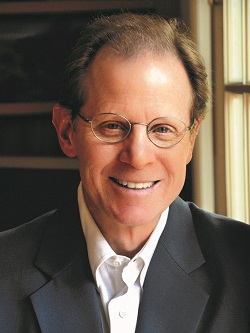
Dan Siegel
How Interpersonal Neurobiology Can Help Shape our Work and our World
Program Information
Dan Siegel
How Interpersonal Neurobiology Can Help Shape our Work and our World
Program Information
Objectives
- Support how clinicians can work with their own presence to better support clients in therapy.
- Practice with your clients how to integrate body and mind for improved well-being.
- Evaluate research on how awareness can shape connections in the brain toward integration.
Outline
- Interpersonal Neurobiology: impact on psychotherapy
- Harnessing the therapist’s presence to improve client outcomes
- Awareness as the path toward integration and “rewiring to inspire”
Target Audience
Deb Dana
Safe & Connected: A Polyvagal Guided Path for Re-Imagining our World
Program Information
Deb Dana
Safe & Connected: A Polyvagal Guided Path for Re-Imagining our World
Program Information
Objectives
- Use your autonomic nervous system to create an environment of safety for clients and others.
- Help clients listen to their internal state and let go of their problem story.
- Reliably guide clients from state to state and enhance capacity for self-regulation.
Outline
- ANS as a basis for communication and healing (autonomic conversation)
- Creating co-regulation to face difficult clinical conversations
- How polyvagal theory can impact clients and our world
Target Audience
Sue Johnson
Using the Science of EFT with Individuals: Bringing Your Clients to Life and Restoring Their Ability to Live Well
Program Information
Sue Johnson
Using the Science of EFT with Individuals: Bringing Your Clients to Life and Restoring Their Ability to Live Well
Program Information
Objectives
- Build core emotional experiences to promote emotional balance in traumatized, anxious, and depressed clients.
- Evaluate the EFT model as a secure base for effective therapy with individuals.
- Analyze the three stages of the EFT model as a way out of destructive patterns.
- Employ evidence-based stages to increase closeness, safe attachment, and connection.
- Construct corrective emotional experiences that create forward movement in a single session.
Outline
- Focusing sessions on core defining factors to shape openness and engagement
- Using the macro-intervention of EFT to move clients into change events
- Consolidating new models of self/other and new ways to grow
Target Audience
Gabor Maté
When the Body Says “No”: Listening to Our Stress & Re-connecting with Our Self
Program Information
Gabor Maté
When the Body Says “No”: Listening to Our Stress & Re-connecting with Our Self
Program Information
Objectives
- Determine neurobiological underpinnings of stress and its effect on the body.
- Analyze three major stressors for humans and their effect on biology.
- Evaluate ways of recognizing stress and preventing it.
Outline
- The nature of stress and its physiological consequences
- The three major stressors we must know about
- How early environment programs chronic stress patterns
- Why stress remains hidden in our culture
- Recognizing and transforming stressful work environments
- Recognizing stress and burnout and preventing it
- Using stress understanding to inform and enhance clinical work
Target Audience
Jessica Schleider
Little Treatments, Big Effects: Single-Session Interventions That Create Lasting Change
Program Information
Jessica Schleider
Little Treatments, Big Effects: Single-Session Interventions That Create Lasting Change
Program Information
Objectives
- Analyze advances in SSI research for youth mental health problems and characteristics of effective SSIs.
- Employ SSI components that reduce internalizing symptoms and improve treatment seeking.
- Determine strategies for evaluating feasibility and effectiveness of SSIs in clinical/research settings.
Outline
- Present state of SSI research
- How to identify and implement clinically useful SSI components
- Accessing a suite of freely available, evidence-based SSIs
Target Audience
Lisa Coyne
The New Exposure Therapy: How Inhibitory Learning Can Improve Outcomes for OCD and Anxiety Disorders
Program Information
Lisa Coyne
The New Exposure Therapy: How Inhibitory Learning Can Improve Outcomes for OCD and Anxiety Disorders
Program Information
Objectives
- Evaluate exposure and response prevention and its efficacy.
- Determine the inhibitory learning model of exposure therapies.
- Analyze how exposure works from the perspective of inhibitory learning.
- Design and conduct exposure exercises that support inhibitory learning.
Outline
- Structuring exposure hierarchies and "menus" consistent with inhibitory learning principles
- Supporting expectancy violation
- Minimizing covert avoidance during exposures
- Improving generalization and maintenance
Target Audience
Skip Rizzo
Clinical Virtual Reality Treatments: A Brief Review of the Future
Program Information
Skip Rizzo
Clinical Virtual Reality Treatments: A Brief Review of the Future
Program Information
Objectives
- Analyze VR and the ways people engage and interact with VR environments.
- Distinguish rationales for VR in assessment/rehabilitation of clinical disorders.
- Determine issues in design, development, implementation, and evaluation of virtual environments.
Outline
- Clinical VR “ingredients” and core concepts
- Theoretical basis & research support (anxiety, addiction, PTSD, pain)
- Assessment & rehabilitation applications (stroke, brain/spinal injury, neurological disorders)
- Virtual humans for training, role playing, and access to care
- Pragmatics, the future, and ethical issues
Target Audience
Janis Phelps
Psychedelic-Assisted Therapy: The Psychotherapy Whose Time Has Come
Program Information
Janis Phelps
Psychedelic-Assisted Therapy: The Psychotherapy Whose Time Has Come
Program Information
Objectives
- Appraise research related to psychedelic-assisted therapy and efficacy across diagnostic categories.
- Evaluate growing utilization of mental health professionals in psychedelic-assisted therapies.
- Investigate neurobiological underpinnings of psychedelic facilitation of psychotherapy.
Outline
- Review of clinical research and outcomes
- Review of neurobiological mechanisms of action
- Review of training and utilization of mental health professionals
Target Audience
Jud Brewer
Tapping into our Brains to Break Anxiety Cycles and Other Habits
Program Information
Jud Brewer
Tapping into our Brains to Break Anxiety Cycles and Other Habits
Program Information
Objectives
- Assess how anxiety forms as a habit.
- Catalogue how mindfulness affects reward valuation in the brain.
- Analyze how mindfulness approaches can help change addictive habit patterns.
Outline
- Current treatment paradigms for anxiety
- How anxiety forms as a habit; how the brain forms habits
- Neuroscientific insights often missed in anxiety treatment
- Reward valuation and behavior change
- Clinical outcomes from digital therapeutics research
- Three-step process for overcoming anxiety and habits
Target Audience
Program Track
Psychopharmacology: Essential Updates for Mental Health Professionals
Program Information
Program Track
Psychopharmacology: Essential Updates for Mental Health Professionals
Program Information
Objectives
- Investigate the proper role of mental health professionals working with clients receiving medications.
- Determine traditional medications for depressive disorders, anxiety disorders, and insomnia.
- Assess recent advances in medications for depressive disorders, anxiety disorders, and insomnia.
Outline
- Why (and what) you should know about psychopharmacology
- Questions from clients/prescribers and how to answer them
- Latest information and newest medications for depression, anxiety, and insomnia
Target Audience
Donald Altman
Essential Mindfulness and Meditation Tools for Today’s Stressed World
3-hour experiential intensive
Donald Altman
Essential Mindfulness and Meditation Tools for Today’s Stressed World
3-hour experiential intensive
In a world facing unprecedented stress, anxiety, and depression, learn targeted mindfulness and meditation tools designed to increase emotional regulation, problem solving, and overall wellbeing—skills designed to be taught and applied in just one session.
Objectives
- Demonstrate how to use the breath to quiet the brain's alert and alarm system.
- Support research behind "security primings" to increase safety and trust.
- Assess risks of stress at the cellular level and integrate experiential exercises to reduce risks.
Outline
- Breathing postures shown to reduce perceived stress and lower blood pressure
- Physical grounding practice for body connection
- Five Steps to G-R-E-A-T Mindful Self-Care
- 4-Mindful Bite Meditation for stress eating
- Savoring methods to enhance positive affect
- G.L.A.D. technique for emotion regulation
Target Audience
Program Track
Getting off the Couch: How to Incorporate Walking Therapy in your Practice
Program Information
Program Track
Getting off the Couch: How to Incorporate Walking Therapy in your Practice
Program Information
Objectives
- Investigate scientific underpinnings of walking-based psychotherapy and appropriate clients.
- Categorize elements of walk-and-talk combining movement, nature, and therapy.
- Propose how to conduct outdoor sessions (others on trail, weather, terrain, using nature).
- Apply mindfulness-based strategies during outdoor walking therapy.
Outline
- Combining nature, movement, and therapy—who it works well for
- Origins, background, research, and history
- Physiological response to movement and mood/anxiety effects
- Demonstration of the approach
- Practical ways to weave nature into the therapeutic process
- Getting started with this format of treatment
Target Audience
Program Track
Embodying Resilience: Using Movement to Navigate Anxiety and Build Personal Power in Children
Program Information
Program Track
Embodying Resilience: Using Movement to Navigate Anxiety and Build Personal Power in Children
Program Information
Objectives
- Build capacity to identify rising anxiety before it becomes overwhelming.
- Manage escalating emotions and intrusive thoughts with movement practices.
- Enhance resilience through simple and accessible personal practices.
Outline
- Anxiety and the brain-body relationship
- Reframing the mental narrative from the body up
- Practices to build internal safety
- Six resilience and anti-anxiety practices (meditation, movement, breath)
Target Audience
Program Track
What’s New with Sex?: The Things Your Clients Don’t Talk About (But Want To)
Program Information
Program Track
What’s New with Sex?: The Things Your Clients Don’t Talk About (But Want To)
Program Information
Objectives
- Apply communication skills to manage anxiety around sex and intimacy.
- Analyze history and current field of sex and couples therapy.
- Analyze contemporary sexual knowledge and clinical relevance.
- Assess sexual wellness and how stereotypes may affect outcomes.
Outline
- AI and sexuality and effects on treatment
- Alternative sexual practices and relationship innovations
- Kink, BDSM, sextech, teledildonics, VR and sex robots—clinical considerations
Target Audience
Program Track
Trauma Focused DBT Skills for Adolescents
Program Information
Program Track
Trauma Focused DBT Skills for Adolescents
Program Information
Objectives
- Investigate traumatic stressors facing adolescents and how to address them.
- Analyze the role of racial injustice and race-based stress and trauma in adolescents.
- Utilize trauma focused DBT skills for adolescents.
Outline
- Why DBT skills training matters for adolescents under stress
- How race-based trauma impacts adolescent development
- DBT strategies to cope, thrive, and build a life worth living
Target Audience
Program Track
Beyond Desire: Navigating Sex and Attachment in a Pandemic World
Program Information
Program Track
Beyond Desire: Navigating Sex and Attachment in a Pandemic World
Program Information
Objectives
- Determine differences between spontaneous and responsive desire among couples.
- Devise ways to address feelings and stressors to strengthen relationships and rekindle desire.
- Assess links between mindfulness practices and enhanced physical sensation.
Outline
- Impacts of stress on sexual function and relationships
- Models of sexual responsiveness
- Resolving effects of stress on sexuality
Target Audience
Program Track
Seeking Safety: An Evidence-Based Model for Trauma and/or Addiction
Program Information
Program Track
Seeking Safety: An Evidence-Based Model for Trauma and/or Addiction
Program Information
Objectives
- Investigate key issues in treating trauma and substance abuse and the linkages between them.
- Evaluate key features of the Seeking Safety model.
- Utilize resources for learning more about trauma and addiction.
Outline
- Present versus past-focused treatment and how to choose
- How Seeking Safety is implemented
- Linkages between trauma and addiction
Target Audience
There is simply no other conference that combines the most forward-thinking experts in the field, the latest cutting-edge advances, and covers the most important issues you are facing as a therapist today.
If you’re ready to learn first-hand from the premier clinicians and researchers... covering the hottest and most pressing issues you face every single day... then this exclusive event recording is for you!
Innovations in Psychotherapy
All-Access Pass
What Clinicians Are Saying
Real feedback from practitioners who wanted practical skills they could use immediately.
“Finally a single place where the newest approaches are explained clearly, with concrete language I can use in session the same week.”
Sara M., LCSW
Outpatient clinician
“The trauma and neuroscience sessions helped me update my case conceptualizations—without the usual jargon. Excellent pacing and practical takeaways.”
Ahmed R., Psychologist
Private practice
“I loved the variety: ACT, IFS, polyvagal, trauma, and the emerging work like single-session interventions—this made my continuing education feel exciting again.”
Nadia K., LMFT
Community mental health
Frequently Asked Questions
Quick answers before you reserve your All-Access Pass.
Who is this training for?
Is this live or self-paced?
Do I get a certificate or CME/CE credits?
How do I access the videos after purchase?
Can I watch on mobile?
You must be logged in to post a review.
Related products
-
Brain Medicine: Integrating the Clinical Neurosciences – 2025 Update
Original price was: $790.00.$144.95Current price is: $144.95. -
Cognitive Behavioral Therapy for Anxiety Disorders
Original price was: $500.00.$94.95Current price is: $94.95. -
Navigating the Frontiers of Autism 2024
Original price was: $890.00.$144.95Current price is: $144.95. -
Compassion Focused Therapy
Original price was: $390.00.$144.95Current price is: $144.95.







Reviews
There are no reviews yet.